BUSINESS ENERGY COMPARISON
Business energy - Is it time to compare quotes and switch?
Compare business energy from a panel of suppliers to take the hassle out of sorting your next energy deal. You choose the rates that are right for your business. We support you with the switch.
By clicking ‘COMPARE TODAY'S RATES’ you agree for us to search your current energy supplier and usage though industry held data. Enter manually

Is it time to compare business energy quotes and switch?
Take the hassle out of sorting your next energy deal. We compare from a panel of suppliers. You choose the rates that are right for your business.
By clicking ‘COMPARE TODAYS RATES’ you agree for us to search your current energy supplier and usage though industry held data. Enter manually
Compare deals from our panel of trusted business energy suppliers

How to compare business energy and switch with MoneySuperMarket
Run a business energy comparison and switch suppliers in three simple steps
1
We find your details
Just give us your business postcode and we’ll use smart data to find out about your business and start your comparison
2
We talk you through your quotes
One of our UK-based energy experts will search our business energy supplier panel and call you to talk through your quotes
3
You choose your supplier
You then choose the energy supplier and contract that best suits your business and we’ll support you with the switch
Business Electricity Comparison
If you want to cut your business costs, start with the basics. Electricity is essential for most businesses but it can be expensive. Comparing quotes to find the cheapest rates from our supplier panel is a quick and easy way to cut your business costs.


Our expert says
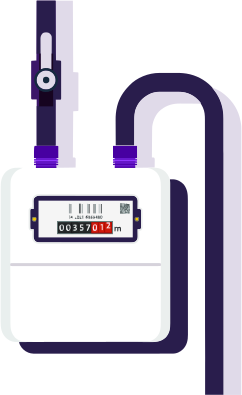
"Small business owners should consider fitting smart meters and energy management platforms to help them better understand their energy use and work out ways to cut costs. Price volatility and a more complex switching process can make the energy market tricky to navigate for small businesses. When you throw in the annoying admin involved, it's no wonder small businesses can be less likely to switch suppliers. But getting help from experts at MoneySupermarket means business owners can get all the information they need to get more cost-effective energy rates. By taking proactive steps to compare and switch, small business owners can overcome the challenges of the current energy market and secure the right energy contract for their businesses."
- Laura Hinton, Commercial Manager
Compare today’s business energy rates
By clicking ‘COMPARE TODAY'S RATES’ you agree for us to search your current energy supplier and usage though industry held data. Enter manually
What are the latest business energy prices for October 2026?
As of October 2026, business gas unit rates range from 8.6p to 8.8p per kWh, depending on business size, according to panel data from our partners at Bionic. This is a month-on-month increase from September. Business electricity unit rates in the UK range from 26.1p to 28.4p per kWh, depending on business size. Also a month-on-month increase from September.
Rates shown may vary, and your actual business energy costs may be higher or lower, depending on factors such as your location and energy efficiency.
Business gas rates October 2026
| Business size | Annual gas usage (kWh) | Unit price per kWh | Standing charge per day |
| Micro business | 5,000 to 15,000 | 8.8p | 44.9p |
| Small business | 15,001 to 30,000 | 8.5p | 49.5p |
| Medium business | 30,001 to 65,000 | 8.7p | 67.3p |
| Large business | More than 65,000 | 8.6p | 61.8p |
Business electricity rates October 2026
| Business size | Annual electricity usage (kWh) | Unit price per kWh | Standing charge per day |
| Micro business | 5,000 to 15,000 | 28.4p | 58.0p |
| Small business | 15,001 to 25,000 | 27.2p | 118.9p |
| Medium business | 25,001 to 50,000 | 27.7p | 90.1p |
| Large business | More than 50,000 | 26.1p | 173.0p |
Note: Prices are correct as of October 2026. Rates and bill size may vary according to your meter type and business location. The prices you’re quoted may be different from the averages shown. The figures shown are the average unit rates and standing charges received by Bionic from our panel of suppliers (inclusive of maximum Bionic commission), per business size thresholds, from October 1 to October 12, 2026.
What is business energy?
Business energy refers to the gas and electricity supplied to commercial premises under a non-domestic contract. Unlike household energy, business energy is not regulated by Ofgem's price cap, and tariffs are not standardised. This means every quote is calculated based on your business's specific needs, usage, and location.
Any organisation that uses energy for commercial purposes qualifies as a business energy customer. That includes sole traders and freelancers working from commercial premises, limited companies, charities, schools, public sector organisations, and landlords of commercial property.
If you work from home but need a commercial energy tariff, you’ll typically need to prove that at least 50% of your energy usage is for business purposes. If you meet these criteria, you may qualify for small business electricity rates. Find out more at our small and micro business energy guide.
Business energy contracts are typically fixed-term, running from one to five years, and are negotiated directly with a supplier or through a comparison service like MoneySuperMarket. Because prices are bespoke and contracts are longer, getting expert help to compare the market, rather than going direct to a single supplier, is usually the most effective way to secure a competitive rate.
Are you on out-of-contract rates?
If your business energy contract has already expired, your supplier will have automatically moved you onto out-of-contract rates. These are typically among the most expensive rates a supplier offers, and because business energy has no Ofgem price cap, there is no ceiling on how high they can go.
Businesses on out-of-contract rates can pay significantly more per kWh than those on a fixed deal. Comparing and switching as soon as possible is the most effective way to reduce your bills immediately. There are no early exit fees to worry about if you're already out of contract, you can switch at any time.
Does the price cap affect business energy rates?
No. The price cap doesn't affect business energy rates. This is because it's only designed to protect domestic energy rates. There's no price cap on business energy.
A change in the price cap can give an idea of where prices are heading, but the price cap doesn't directly affect business energy prices. As a business owner with a non-domestic contract, the only way to avoid price volatility is to switch to a fixed-rate contract.
If you're currently out of contract or your current deal is up for renewal, now could be a good time to run a comparison to lock in your business gas and electric rates.
Why compare business energy with MoneySuperMarket?
Comparing business energy can save you time and money. We use smart data to find out all we need to know about your business, its energy use, and its current supplier. This can help cut the time it takes to compare business gas and electricity prices.
Once we have this information, we can compare rates from our panel of energy suppliers to help save you money on your next contract. You choose the deal that best suits your business, and we’ll help make sure the switch goes as smoothly as possible.
If you’re used to switching household energy suppliers, you probably know your way around the comparison process. But switching business energy is a bit different. Unlike domestic "off-the-shelf" tariffs, business energy tariffs are tailored to your specific needs.
That’s why our UK-based energy experts are on hand to help you compare deals and support you through the switch.
How to compare business energy tariffs per kWh
Comparing business electricity and gas tariffs can be complicated because you need separate quotes for each fuel. This can make it more difficult to work out which deal is the best value for your business. That’s why it’s often handy to get some expert help.
When running a business gas and electric comparison, the first thing to look out for is the unit rate. This is measured in kilowatt hours (kWh) and is the price you pay for the energy you use.
You then need to look at the standing charge. This is a flat daily fee you pay regardless of how much commercial power you use. This covers the costs of things like maintaining the energy network, meter readings, and operating costs.
If you know these figures and have an idea of how much energy you use, you can roughly work out the cost of your monthly and annual business energy bills.
The average prices per kWh and standing charges shown below should give you an idea of what you can expect to pay, based on the size of your business.
Do you need a business energy broker?
A business energy broker is a company or individual who compares contracts from multiple suppliers on your behalf and helps you secure the best deal. Brokers can be particularly valuable for businesses with complex energy needs, such as large sites, multi-meter properties, or high consumption, where bespoke procurement is more cost-effective than a standard online comparison.
Brokers are also useful for smaller businesses as the swithcing process isn't quite as simple as it is for home energy.
MoneySuperMarket has partnered with Bionic to work with a panel of trusted business energy suppliers. Our experts act on your behalf to find the most competitive rates available to your business. Unlike going directly to a single supplier, comparing with us means you get quotes from across the market in a single call, without any obligation to switch.
It's worth knowing that business energy brokers are regulated under Ofgem's Microbusiness Strategic Review, which introduced new protections from 2022 requiring brokers to be transparent about any fees or commissions they receive. When you compare through MoneySuperMarket, our remuneration structure is disclosed as part of the comparison process.
You can find out more in our guide to business energy brokers.
What affects the price of business energy?
The amount you pay for business energy is mainly affected by the wholesale cost of gas and electricity. This is the price your supplier pays for the energy it supplies to your business, and it can be impacted by anything from natural disasters to political events and conflicts.
There are lots of other factors that affect how much you pay for business energy, including:
- The type of business you own. This dictates the patterns of energy consumption during the week, because not all businesses work Monday to Friday, 9.00 am to 5.00 pm. Businesses that use a lot of energy during the evenings and weekends will be charged different rates compared to the daytime - these rates are usually lower, because there’s less demand on the network.
- The annual energy use at your business. Suppliers usually offer slightly lower rates to large and industrial businesses that use a lot of energy. But if unit rates go down, sometimes the daily standing charge will go up. It’s always best to check your overall offer in terms of the cost for a full year, rather than just looking at unit prices.
- The size of your business. Your buying power can depend on whether you run a small business or a large corporation. Suppliers always look at the size of a business and its usage levels to calculate rates.
- The length and type of contract you have. Fixed-rate contracts often come with lower rates than variable contracts. If you lock in your rates for longer, your supplier should offer preferential prices. But if you let a fixed contract expire without lining up a new one to replace it, you’ll be placed on out-of-contract rates, which can be more than 33% higher.
- Your current energy provider. You could already be with the most or least expensive supplier on the market, but you won’t know until you compare tariffs.
- Where your business is located. The region your business is in affects the quotes you’ll get, because prices vary around the country. This usually depends on how difficult it is to supply a certain area. For example, Scotland has some of the highest prices in the UK, whereas the Midlands has some of the lowest.
Suppliers use this information to work out the cost of your quote. This includes the unit rate, standing charge, and any other fees, taxes, and levies that apply.
Fixed-term business energy deals offer the best way to save money and take control of your bills. But it’s not the only thing that will affect prices.
As well as fluctuations in the wholesale price of gas and electricity, some suppliers will offer to include maintenance and care of your commercial gas system as part of their contract. Make sure you check how much this will cost and weigh up whether it provides the best value for money.
What's the difference between domestic and business energy?
Business energy contracts are built around your business, not a generic household rate. Suppliers price your deal based on many things, including your location, usage, staff numbers and industry. Unlike home energy, there are no off-the-shelf tariffs.
There are a few other key differences too:
- You can lock in business rates for up to five years, rather than the usual 12-month domestic deal
- There's no business dual fuel discount. Gas and electricity are always billed separately, even with the same supplier
- Once you sign, there's no cooling-off period, so it pays to get the details right the first time.
- Switching rules differ too.
- You can only move suppliers within your contract's switching window, typically up to six months before your end date, unless you're already out of contract. And the switch won't complete until your current contract ends.
For more detailed info, read our full guide: Is business energy different to household energy?
How long does it take to switch business energy?
If you're on your supplier's out-of-contract, you can switch at any time. The time it takes to switch depends on the size of your business and things like whether you owe your current supplier money. If you run a micro business, then the switch should take no longer than five days. For businesses of other sizes, it can take up to 30 days.
If your business is still under contract with its current supplier, your new contract won't take effect until this one expires. This means that if you sign a new contract in January but your existing one doesn't end until June, you won't pay the new rates for six months.
But if prices increase during that time, comparing business energy quotes and locking in rates early can save you money. That's why it makes sense to run a business energy comparison as soon as your current contract enters its switching window.
Extra protections for micro businesses
If your business qualifies as a micro business under Ofgem's definition - broadly, fewer than 10 employees and an annual turnover or balance sheet of no more than €2 million - you benefit from stronger consumer-style protections when buying energy.
These include the right to give notice and switch suppliers at any point in your contract (subject to a notice period), a requirement for your supplier to give you advance notice before your contract ends and what rates you'll move to if you don't switch, and access to the Energy Ombudsman to resolve disputes if you can't agree with your supplier directly.
Ofgem's Microbusiness Strategic Review significantly strengthened protections. This came into force in 2022 and continues to be updated. If you're unsure whether your business qualifies, our experts can advise when you compare. Small businesses have also benefited from increased protections since a 2024 review.
Moving business premises? Here's what to do about your energy
If your business is moving to new premises, you'll need to set up a new business energy contract at your new address rather than simply transferring your existing one. The process is known as a change of tenancy (CoT), and it applies whether you're taking on a vacant commercial property or moving into a space previously occupied by another business.
When you move in, you'll automatically be placed on the existing supplier's deemed rates until a new contract is agreed, which can be expensive. Contacting a comparison service as early as possible, ideally before you take possession of the premises, means you can compare rates and line up a competitive deal from day one.
If you're leaving the premises, you'll need to provide a final meter reading to your current supplier and settle any outstanding balance. Your gas and electricity supply will continue for the incoming occupier under the same supplier until they arrange their own contract.
You can read the full process in our change of tenancy guide.
How to compare business energy with MoneySuperMarket
As a busy business owner, it’s unlikely you’ll have the time to ring around a range of suppliers for bespoke business gas and electricity quotes. That’s where the energy experts at MoneySuperMarket can help.
One call to us is all it takes for us to compare tariffs for you from our panel of energy suppliers. We only need your postcode to start a MoneySuperMarket business energy comparison. We then use smart data to find out more about your business and its energy usage. Once we have all the info we need, we can find a competitive deal that suits the needs and budget of your business.
The final decision is always with you – we supply the quotes, and you pick the one you like best.
Give our business energy experts a call now on 0800 140 4667.
Business energy FAQs
To help you better understand how business energy switching works, here are the answers to some frequently asked questions.
Our experts share essential knowledge on business energy








If you don’t complete the form we may use your details to understand what went wrong or to promote our products or special offers. We may contact you by phone or email.
Contact MoneySuperMarket.com at MoneySuperMarket House, St David's Park, Ewole, Flintshire, CH5 3UZ. © MoneySuperMarket.com Ltd 2013.
Moneysupermarket.com Limited is an appointed representative of Moneysupermarket.com Financial Group Limited ©, which is authorised and regulated by the Financial Services Authority (FSA FRN 303190). Moneysupermarket.com Financial Group Limited, registered in England No. 3157344. Registered Office: Moneysupermarket House, St. David's Park, Ewloe, CH5 3UZ. Telephone 01244 665700.
Important Information
Here's some important information about the services MoneySuperMarket provides. Please read and retain for your own records. About our service


We use cookies to ensure you have the best experience on our website. Cookie Policy